Northern Lights in Iceland
Iceland sits under the auroral oval, so on many clear, dark nights between late August and mid-April there is something to see - often faint, sometimes overwhelming. Whether you see it comes down to three things you can check: how dark the night is, whether there is cloud above you, and how much light the moon adds. The aurora's own strength matters less than visitors are told. This page puts numbers on all of it, computed from Icelandic Met Office data and the sun's position rather than repeated from other guides.
The Season Is Set By Darkness
The aurora does not switch off in summer; the sky simply never gets dark enough to show it. The Met Office's own aurora forecast prints a nightly "Dark" window for Reykjavík, and it begins when the sun is 6° below the horizon - the end of civil twilight. On 1 October 2026 it read 19:45 to 06:52; by our calculation the sun crossed 6° at 19:44 and 06:51. The University of Alaska Fairbanks Geophysical Institute, which sits at almost the same latitude as Reykjavík, uses the same line: active aurora "can generally be seen after civil twilight". Faint displays need a darker sky, so the table also gives nautical darkness, with the sun 12° down.
| Month | Reykjavík, sun 6° down | Reykjavík, sun 12° down | Akureyri, sun 6° down | Akureyri, sun 12° down |
|---|---|---|---|---|
| August | 5.6 h | 1.9 h | 4.9 h | 1.2 h |
| September | 9.4 h | 7.3 h | 9.2 h | 7.0 h |
| October | 12.7 h | 10.8 h | 12.8 h | 10.8 h |
| November | 15.5 h | 13.5 h | 15.8 h | 13.7 h |
| December | 17.1 h | 14.8 h | 17.6 h | 15.1 h |
| January | 16.2 h | 14.1 h | 16.6 h | 14.3 h |
| February | 13.7 h | 11.8 h | 13.8 h | 11.8 h |
| March | 10.6 h | 8.6 h | 10.5 h | 8.4 h |
| April | 6.9 h | 3.8 h | 6.5 h | 2.9 h |
| May | 1.8 h | 0.0 h | 1.0 h | 0.0 h |
So the season has soft edges. In Reykjavík the first moment of darkness after summer came on 24 July 2026, but those early nights are minutes long; nautical darkness returns on 15 August 2026 and lasts until 26 April 2027, and that is where "late August to mid-April" comes from. Akureyri, further north, starts and ends a few days later and earlier. At the other extreme, the longest night of the year gives 17.2 hours of darkness in Reykjavík and 17.7 in Akureyri; even Grímsey, on the Arctic Circle, gets about 18. Claims of twenty hours of darkness in December are wrong for anywhere in Iceland.
Which Month Is Best?
The usual advice is to choose a month with clear skies. The Met Office's own station records undercut it: across 1991-2020, average cloud cover hardly moves through the aurora season. In Reykjavík every month from September to April averages between 5.7 and 6.0 eighths of the sky covered. November, often described as one of the cloudiest months, is in fact Reykjavík's least cloudy, by a hair. Akureyri is cloudier than Reykjavík all season, with October its worst month.
| Station | Sep | Oct | Nov | Dec | Jan | Feb | Mar | Apr |
|---|---|---|---|---|---|---|---|---|
| Reykjavík | 6.01 | 5.71 | 5.70 | 5.78 | 5.95 | 5.91 | 5.88 | 5.74 |
| Keflavík Airport | 6.11 | 5.90 | 5.93 | 5.93 | 6.04 | 6.01 | 6.03 | 5.91 |
| Stykkishólmur | 6.28 | 6.19 | 6.09 | 6.12 | 6.24 | 6.11 | 6.10 | 5.97 |
| Akureyri | 6.14 | 6.32 | 6.19 | 6.25 | 6.24 | 6.20 | 6.18 | 6.02 |
| Dalatangi (east coast) | 6.12 | 6.19 | 6.00 | 5.80 | 5.81 | 5.84 | 5.91 | 6.17 |
What the cloud table can and cannot tell you. These are monthly means of every observation, day and night, so they say how cloudy a month is on average, not how many nights are clear. They are still the best public record there is, and they make one point clearly: the difference between months is far smaller than the difference between one night and the next, or between one side of the country and the other on the same night. Reykjahlíð at Mývatn, often recommended for clear skies, is left out because its file holds only 18 to 20 of the 30 years.
What does differ between months is darkness and activity. Darkness peaks in November to January. Geomagnetic activity peaks around the equinoxes: the University of Alaska Fairbanks puts the statistical likelihood of aurora over Interior Alaska at "roughly twice as high on the equinox as it is at solstice", the so-called Russell-McPherron effect. We have not found an Iceland-specific figure; the effect is global, but we cannot state its size here. Multiplying Reykjavík's dark hours by the share of sky its average cloud leaves open gives a rough sense of the trade-off - more open dark sky in midwinter, more activity per hour around the equinoxes:
| Month | Sep | Oct | Nov | Dec | Jan | Feb | Mar | Apr |
|---|---|---|---|---|---|---|---|---|
| Open dark sky, h per night | 2.3 | 3.6 | 4.5 | 4.7 | 4.2 | 3.6 | 2.8 | 1.9 |
Our reading: no month is a bad choice from September to March, the length of your stay matters more than its date, and the month should be picked for everything else you want from the trip - open highland roads in September, ice caves from November, the equinox and longer days in March. The month guides for September, October, November, December, January and February cover the rest.
Reading The Met Office Forecast
The aurora forecast at en.vedur.is combines a cloud-cover map of Iceland, a slider running several days ahead, an activity score for midnight on a 0-9 scale, and Reykjavík's times for sunset, darkness, sunrise and moonrise. On the map, green is cloud and white is clear sky.
The 0-9 score is the Kp-index, a global measure of how disturbed the Earth's magnetic field is. The Met Office's guidance is the most useful sentence on the subject: "Even grade 2 (low activity) can be beautiful and grade 3 (moderate) can be dazzling." It also states that Kp is 0 to 4 about 90% of the time and 7 to 9 only about 1% of the time, so the high numbers that make headlines are rare. Iceland does not need them: the Met Office notes the auroral oval lies just north of the country by day and moves over it in the evening. Those explanatory articles date from 2012; the physics has not changed.
In practice the cloud map does more work than the activity score. A 2 under a clear sky beats a 5 under overcast, and the cloud map shows where the gaps are. Two features of the activity forecast are worth knowing: the particles that drive the aurora take one to three days to travel from the sun, so major storms can usually be seen coming; and because the sun turns once about every 27 days, a disturbance can recur about four weeks later.
What Time Of Night
The University of Alaska Fairbanks recommends the three or four hours centred on midnight, when displays tend to be most active. In Iceland, read "midnight" as the middle of the night rather than 12 on the clock: the sun reaches its lowest point at 01:13 to 01:41 in Reykjavík through the season, because Icelandic clock time runs well ahead of the sun. The dark window on any date tells you how long you have.
| Night of | Dark from - to | Hours |
|---|---|---|
| 15 August | 22:47 - 04:17 | 5.5 |
| 1 September | 21:36 - 05:19 | 7.7 |
| 15 September | 20:42 - 06:04 | 9.4 |
| 1 October | 19:44 - 06:51 | 11.1 |
| 15 October | 18:56 - 07:32 | 12.6 |
| 1 November | 18:03 - 08:20 | 14.3 |
| 15 November | 17:27 - 08:59 | 15.5 |
| 1 December | 16:57 - 09:37 | 16.7 |
| 21 December | 16:48 - 10:03 | 17.2 |
| 15 January | 17:26 - 09:46 | 16.3 |
| 1 February | 18:11 - 09:09 | 15.0 |
| 15 February | 18:52 - 08:29 | 13.6 |
| 1 March | 19:33 - 07:44 | 12.2 |
| 15 March | 20:15 - 06:56 | 10.7 |
| 1 April | 21:08 - 05:53 | 8.7 |
| 15 April | 21:56 - 04:57 | 7.0 |
The Moon
A full moon will not hide a strong display, but it washes out the faint ones. The University of Alaska Fairbanks adds a twist: moonlight can make colours easier to see, because it wakes the colour-sensitive cone cells in the eye, while in real darkness the eye relies on rods, which see in black and white. That is why a faint aurora often looks grey-white to the eye and green on a camera screen. For photography, new moon is best.
| New moon - darkest skies | Full moon - brightest skies |
|---|---|
| 10 October 2026 | 26 October 2026 |
| 9 November 2026 | 24 November 2026 |
| 9 December 2026 | 24 December 2026 |
| 7 January 2027 | 22 January 2027 |
| 6 February 2027 | 20 February 2027 |
| 8 March 2027 | 22 March 2027 |
| 6 April 2027 | 20 April 2027 |
Where To Watch
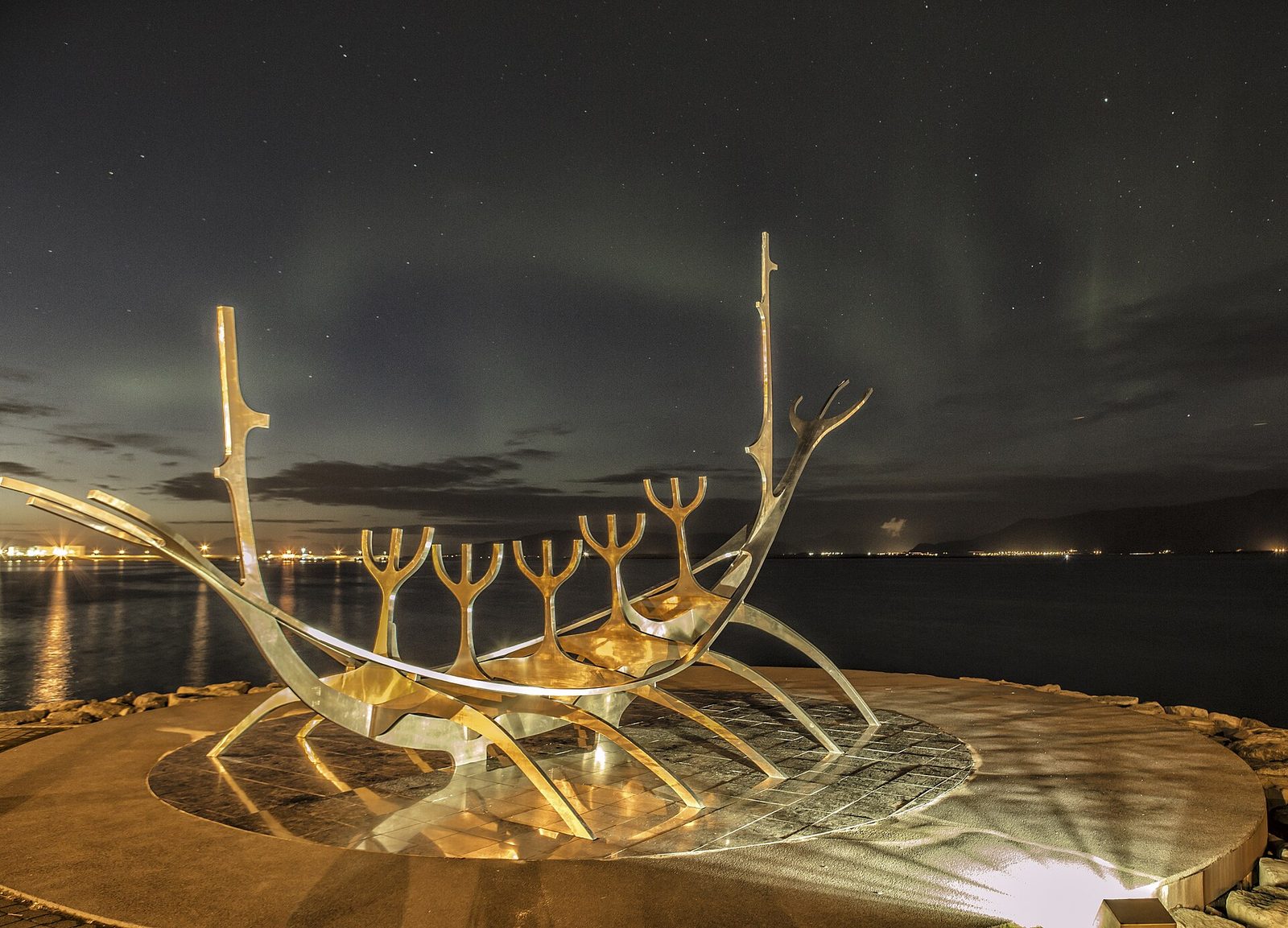
Anywhere dark with a view of the northern sky. In Reykjavík, Visit Reykjavík suggests Grótta, at the tip of the Seltjarnarnes peninsula, and the wooded hill of Öskjuhlíð as darker places within the city; the photograph at the top of this page was taken on the waterfront, in full city light. Beyond the suburbs, the move that pays is not driving to a famous spot but driving to the clear sky the cloud map shows, which on a given night may be in the opposite direction. A geothermal pool under an open sky is the most comfortable way to wait - our hot springs directory lists which are open in winter.
Stopping By The Road: What The Law Says
The temptation on a clear night is to pull over wherever the sky looks good. Icelandic law is more restrictive than many drivers assume. The Traffic Act, Umferðarlög nr. 77/2019, article 28, says a vehicle may not be stopped or parked in a way that may cause danger or unnecessary inconvenience to other traffic, and that outside built-up areas you may only stop on the right-hand side of the road, at the outer edge of the carriageway or off it where possible. Article 29 bans stopping:
- at or near a blind crest or a bend, or anywhere else visibility is reduced;
- in a tunnel, on a bridge or under one - which includes Iceland's many single-lane bridges;
- where a solid centre or lane line divides the road, or so close to one that it makes it hard to get into the right lane;
- at junctions and on roundabouts.
Use a marked pull-out or a car park, get fully clear of the road before switching your lights off, and remember that on a dark rural road the next driver is probably looking at the sky too. Our winter driving guide and rules of the road cover the rest.
Tours Or Self-Drive
Nothing about the aurora requires a tour; a car, the cloud map and patience do the same job. What a tour buys is a guide who knows where the gaps tend to open, someone else driving on icy roads at 1am, and a go/no-go decision made for you. If you book one, read what happens when the bus runs and the sky stays empty: none of the five operators we compared refunds a tour that went out, and their retry terms differ a great deal. Our day-tour weather policies comparison sets out five operators' published terms side by side.
Photographing It
Visit Reykjavík notes that modern phones handle the aurora increasingly well, especially held steady in a pro or manual mode; a camera on a tripod still catches far more. Its starting settings are manual mode, ISO 800-1600, a wide aperture around f/2.8-f/4, a 5-20 second exposure and focus set to infinity. The photograph at the top of this page was a 15-second exposure at ISO 800 and f/6.3. Cold drains batteries quickly, so carry a spare in an inside pocket.
Is The Solar Maximum Over?
Yes, but it matters less in Iceland than the headlines suggest. The Royal Observatory of Belgium's solar data centre (SIDC) confirmed that Solar Cycle 25 peaked in October 2024, with a smoothed monthly sunspot number of 161, and said the Sun would "remain at a similar level of activity well into 2026", listing major storms in October 2024, June 2025 and January 2026. The great storms that push the aurora over southern Europe follow the cycle. Iceland, under the oval, sees aurora at the low-to-moderate activity levels the Met Office says can already be beautiful, and those occur in every phase of the cycle.
Five Claims To Ignore
| Claim | What the evidence says |
|---|---|
| You need Kp 5 or more | The Met Office says grade 2 "can be beautiful" and grade 3 "can be dazzling". Kp is 0-4 about 90% of the time. |
| December is the best month because it is darkest | Darkest, yes - 17.2 hours at most in Reykjavík. But cloud is no lower, and activity tends to be lower at the solstice than at the equinoxes. |
| Pick the month with the clearest skies | Reykjavík's monthly average cloud cover spans just 5.70 to 6.01 octas from September to April. Nights and places differ far more than months do. |
| The season starts in September | Nautical darkness returns to Reykjavík on 15 August 2026. The photograph on our when to visit page shows an aurora over Jökulsárlón on 31 August. |
| There are twenty hours of darkness in midwinter | 17.2 hours in Reykjavík, 17.7 in Akureyri, about 18 on Grímsey at the Arctic Circle. |
Frequently Asked Questions
When Is The Northern Lights Season In Iceland?
From late August to mid-April. The aurora is overhead in other months too - what ends the season is daylight, not the lights. In Reykjavík the sun first sank more than 6° below the horizon, the Met Office's definition of dark, on 24 July 2026, and darkness last returns on 18 May 2027; but the short nights at either end leave little viewing time. Nautical darkness, which faint displays need, runs from 15 August 2026 to 26 April 2027 - which is why "late August to mid-April" is the usual answer.
What Is The Best Month To See The Northern Lights In Iceland?
There is no clear winner, and anyone who names one is simplifying. The darkest months, November to January, give the most hours of darkness - up to 17.2 a night in Reykjavík. The equinox months, September-October and March, have higher geomagnetic activity: the University of Alaska Fairbanks puts the likelihood of aurora over Interior Alaska at roughly twice as high at the equinox as at the solstice. Cloud, the factor people expect to decide it, barely varies - Met Office records for 1991-2020 show Reykjavík between 5.7 and 6.0 eighths of sky covered in every month from September to April. Pick the month that suits the rest of your trip, and stay several nights.
What Kp Do You Need To See The Northern Lights In Iceland?
Less than most guides suggest. The Icelandic Met Office expresses its aurora forecast on the Kp-index, 0 to 9, and says that "even grade 2 (low activity) can be beautiful and grade 3 (moderate) can be dazzling". Iceland lies under the auroral oval - the Met Office notes the oval sits just north of Iceland by day and moves over it in the evening - so it does not need the storms that bring the aurora to southern Europe. Since Kp is 0 to 4 about 90% of the time, waiting for a 5 means waiting through most of the good nights.
Can You See The Northern Lights From Reykjavík?
Yes, when the display is strong enough to beat the city lights. Visit Reykjavík points to Grótta and Öskjuhlíð as darker spots inside the city, and the photograph at the top of this page was taken on the waterfront by the Sun Voyager sculpture. A short drive out of town, away from street lighting, shows far more of a faint display.
Does The Full Moon Stop You Seeing The Northern Lights?
It hides the faint parts but not a good display. The University of Alaska Fairbanks Geophysical Institute notes that a full or nearly full moon can keep you from seeing dim auroral features, but that moonlight can also bring out the colours, because it switches on the colour-sensitive cells in the eye. Photographers do better around the new moon. In the 2026-27 season the new moons fall on 10 October, 9 November, 9 December, 7 January, 6 February, 8 March and 6 April.
Can You Stop Your Car By The Road To Watch The Northern Lights?
Only where it is safe and legal, which rules out a lot of Iceland's road shoulders. The Traffic Act (Umferðarlög nr. 77/2019, articles 28 and 29) forbids stopping in a way that may cause danger to other traffic, and specifically at or near a blind crest or a bend, on or under a bridge, in a tunnel, or where a solid line divides the lanes. Outside towns you may only stop on the right-hand side. Use a proper pull-out or car park, turn your lights off only once you are fully off the road, and keep children and tripods off the carriageway.
Sources
Forecast description, the Kp distribution and the grade guidance from the Icelandic Met Office aurora forecast and its articles on reading the forecast, aurora and the magnetic field and space weather predictions (all 2012), read 1 October 2026. Cloud cover computed from the "n" column of the Met Office's monthly station files for 1991-2020. Darkness, dark windows and solar midnight computed from the sun's position (PyEphem) for Reykjavík and Akureyri, and checked against the Met Office's printed "Dark" window. Moon phases and the 2026 equinox and solstice checked against the US Naval Observatory. Equinox effect, viewing hours and moonlight from the University of Alaska Fairbanks Geophysical Institute. Solar cycle from SIDC. Stopping rules from Umferðarlög nr. 77/2019, articles 28-29. City viewing spots and camera settings from Visit Reykjavík. Photograph by john.purvis via Wikimedia Commons. The moon table expires after April 2027.

Last updated: 2026-10-01 · Reviewed against official sources.