Hot Springs in Iceland You Can Bathe In
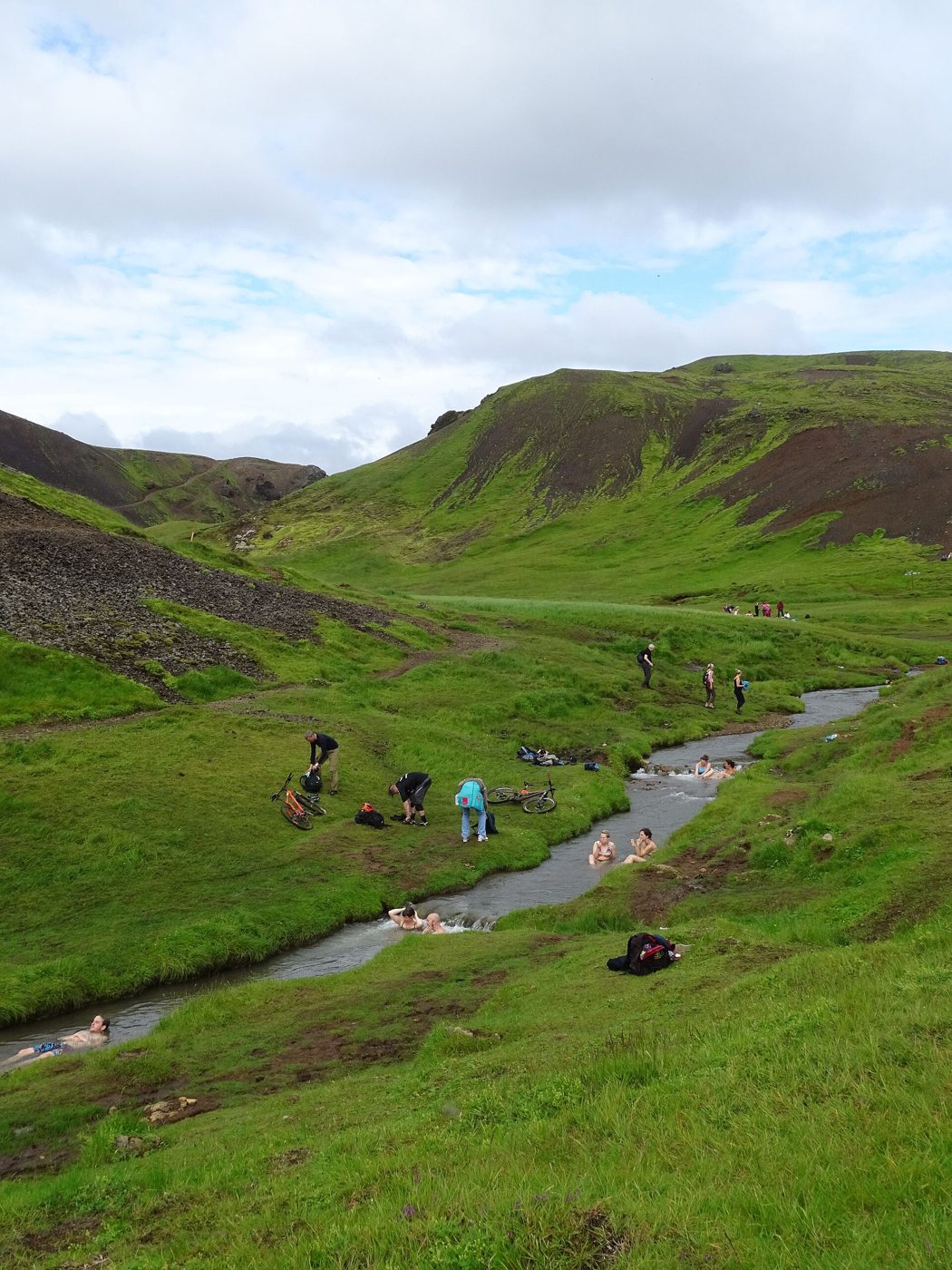
Iceland has dozens of hot springs and geothermal baths warm enough to bathe in, in every region of the country. They range from free wild pools you hike to, to ticketed lagoons with showers and cafés. This guide lists the bathable springs and baths region by region - around thirty in all - with their type, cost and key tips. Ten have full factsheets linked below, and every figure is checked against official sources and dated. It also answers a question no other guide we surveyed addresses at all: which of these sites carry routine water testing and supervision under Icelandic law, and which carry none.
Featured Factsheets
We maintain detailed, frequently-updated factsheets for these springs: Reykjadalur, Reykjaböð, Laugarás Lagoon, Earth Lagoon (Mývatn), Landmannalaugar, Hrunalaug, Seljavallalaug, Hvammsvík, Sky Lagoon, Landbrotalaug. Each covers directions, current costs, water temperature, facilities and FAQs. The full regional directory below places these alongside every other bathable spring and geothermal bath in Iceland, so you can pick by location, budget and the kind of experience you want.
Natural Springs vs Developed Baths
Bathing spots in Iceland fall into two broad types. Natural hot springs are geothermal pools in wild or lightly-built settings, usually free or donation-based, with few or no facilities. Developed baths and lagoons are ticketed sites with changing rooms, showers and managed temperatures, from the famous Blue Lagoon to small regional spas. The directory marks each entry so you know what to expect before you go.
Which Of These Are Legally Regulated, And Which Are Not
This is the part almost no guide covers, and it changes how you read the directory below. Iceland runs two separate bathing regimes, and most of the famous "natural hot springs" sit outside the one visitors assume applies to them.
Every constructed pool and bath - municipal pools, the big lagoons, hotel hot tubs - falls under Reglugerð nr. 814/2010. That instrument sets chlorine limits, sampling regimes, a hard ceiling of 44 °C on pool water ("Hitastig vatns skal ekki fara yfir 44°C", 12. gr.) and continuous lifeguard cover whenever anyone is in the water ("Á sund- og baðstöðum skal ávallt vera laugargæsla meðan gestir eru í laug", 11. gr.). It then excludes natural sites from all of it in one sentence, in 1. gr.: "Reglugerðin gildir ekki um sjóböð og baðstaði í náttúrunni." - The regulation does not apply to sea bathing or to bathing sites in nature.
Natural sites fall under Reglugerð nr. 460/2015 instead, which sorts them into three classes. Only the first two carry an operating licence and routine water testing.
| Class | What it covers | Operating licence | Routine water sampling |
|---|---|---|---|
| 1 | Sites under regular operation, with regular visitor numbers year-round. Class 1 sites require an operating licence. | Required | At least 10 a year for E. coli and intestinal enterococci, proportionally fewer if the site operates for only part of the year |
| 2 | Sites under occasional operation, with visitor numbers that may be regular or seasonal. Class 2 sites require an operating licence. | Required | At least 2 a year, at the start and middle of the peak season |
| 3 | Sites where there is no operation at all. Visitor numbers may be regular or seasonal. | None | None provided for, unless the health committee sees a specific reason |
Class 3 is where most of the famous wild springs sit, and the regulation is explicit about what it does not require there: "Ekki er gert ráð fyrir sérstökum sýnatökum á baðstöðum í 3. flokki nema heilbrigðisnefnd telji sérstaka ástæðu til, til dæmis ef grunur er um mengun eða hættu á útbreiðslu sjúkdóma." - No particular sampling is provided for at class 3 bathing sites unless the health committee considers there is special reason for it, for example where contamination or a risk of disease spread is suspected. Beyond that, 460/2015 contains no lifeguard requirement and no maximum water temperature at all. Its only scald safeguard is a discretionary power for the local health committee to put up warning signs "þar sem hætta er á bruna af heitu vatni".
So which natural sites hold a licence? The agency must publish the class 1 and class 2 list by 1 March each year, and this is it in full, read on 6 September 2026: 16 named sites across 14 venues. Read it for what it is - the register for one of the two regimes, not a national list of the bathing places allowed to operate in Iceland. Most of the ticketed lagoons in the directory below are absent from it, and that is entirely normal: a constructed pool is licensed under 814/2010 instead ("Sund- og baðstaðir skulu hafa starfsleyfi viðkomandi heilbrigðisnefndar", 5. gr.), by the same local health committee, and we could find no national register of those licences to publish alongside this one.
| Site, as the agency names it | Class | Health district |
|---|---|---|
| Vök Baths, Vök við Urriðavatn, 701 Egilsstaðir | 1 | Austurland (HAUST) |
| Bláa Lónið - Heilsulind | 1 | Suðurnes (HES) |
| Bláa Lónið - Lækningalind | 1 | Suðurnes (HES) |
| Bláa Lónið - Retreat | 1 | Suðurnes (HES) |
| Baðlónið - Mývatnssveit | 1 | Norðurland eystra (HNE) |
| Ylströndin í Nauthólsvík | 1 | Reykjavík (HER) |
| Krauma ehf | 1 | Vesturland (HVL) |
| Hótel Húsafell ehf, rekstur Giljabaða | 1 | Vesturland (HVL) |
| Lýsuhólslaug | 1 | Vesturland (HVL) |
| Hreppslaug | 1 | Vesturland (HVL) |
| Gamla Laugin, Hvammur, 854 Flúðir | 1 | Suðurland (HSL) |
| Laugarfell, Fljótsdalshrepp, 701 Egilsstaðir (2 setlaugar) | 2 | Austurland (HAUST) |
| Reykir á Reykjaströnd | 2 | Norðurland vestra (HNV) |
| Hveravellir | 2 | Norðurland vestra (HNV) |
| Hjalteyri ehf, Hörgársveit | 2 | Norðurland eystra (HNE) |
| Ströndin, Langasandi - Akranes | 2 | Vesturland (HVL) |
The absences are worth reading closely, because they mean opposite things. Reykjadalur, Landmannalaugar and Seljavallalaug are missing because nobody operates them: class 3 requires no licence, so holding none is their correct legal status, not a failing. Sky Lagoon, Forest Lagoon, GeoSea and most of the other ticketed venues below are missing for the opposite reason - they are constructed pools, licensed under the other regulation, and were never candidates for this list. The Westfjords hot pots belong to the first group rather than the second: three health districts returned no licensed natural bathing site at all in either class, and the Westfjords is one of them. Hveravellir does appear, in class 2. The Blue Lagoon appears three times, as three separately licensed lagoons at one venue, which is why the site count and the venue count differ.
What this list does not tell you. It is not a register of the bathing places that may lawfully operate in Iceland, and nothing on this page should be read as saying that a site missing from it is operating unlawfully. A site can be absent for three ordinary reasons: it has no operator and so needs no licence, it is a constructed pool licensed under Reglugerð nr. 814/2010 instead, or its local health committee classified it in a way we cannot see - that classification is the committee's decision rather than something derivable from the regulation, so we report the published result and do not infer one. What absence does tell you is narrower, and it is the part worth carrying to a wild spring: where there is no operator, 12. gr. means no routine sampling is provided for. Two presentational notes on our table: the register puts Krauma, Giljaböð, Lýsuhólslaug and Hreppslaug in a single Vesturland cell, which we have split into one row each; and we found the agency publishing water-quality results for a venue that does not appear in its own table. Treat the register as a compliance record, not a directory.
One thing is settled, and it runs the other way. The springs themselves are specially protected: Lög um náttúruvernd nr. 60/2013, 61. gr., 2. mgr. b, lists "hverir og aðrar heitar uppsprettur ásamt lífríki sem tengist þeim" among the geological features enjoying special protection. That is a planning and permitting regime aimed at development works, though - it is not a rule of conduct for bathers, and we will not present it as one.
Hot Springs By Region
Reykjavík & Reykjanes (Southwest)
| Spring / bath | Type | Cost | Notes |
|---|---|---|---|
| Blue Lagoon | Developed | Paid (from ~11,990 ISK) | Famous milky-blue silica lagoon on the Reykjanes peninsula; pre-booking essential. Comfort from 11,990; Premium 14,990; Signature 18,490. |
| Sky Lagoon | Developed | Paid (from ~14,990 ISK) | Oceanfront infinity lagoon with the seven-step Skjól ritual, minutes from central Reykjavík. Saman from 14,990; Sér (private changing) from 17,990. |
| Nauthólsvík Geothermal Beach | Developed | Paid (1,500 ISK) | Man-made geothermal beach lagoon within Reykjavík, run by the city. Admission is charged year-round: adults 1,500 ISK, under-10s free with a guardian, 10–17 400 ISK (price list effective 5 May 2026). The sea lagoon is only heated during opening hours in the summer months. |
South & Golden Circle
| Spring / bath | Type | Cost | Notes |
|---|---|---|---|
| Reykjadalur | Natural | Free | Hike-in hot river above Hveragerði; ≈36–40 °C. |
| Reykjaböð Hot Springs | Developed (new) | Paid (from ~7,900 ISK) | New lagoon and Nordic bathhouse at the foot of Reykjadalur valley in Hveragerði; opened 5 September 2026. Hot springs pass from 7,900 ISK, bathhouse pass from 15,900 ISK. |
| Secret Lagoon (Gamla Laugin) | Developed (historic) | Paid (~4,200 ISK; see note) | One of Iceland's oldest pools, in Flúðir; water 38–40 °C. The operator publishes prices only inside its booking system, so check the current rate when booking. |
| Hrunalaug | Natural (managed) | Paid (~3,000 ISK) | Small stone pools near Flúðir; now ticketed. |
| Laugarás Lagoon | Developed | Paid (from ~6,900 ISK, Birki admission) | Iceland's newest Golden Circle spa (opened 2025); two-storey pools linked by a cascading waterfall, between Geysir and Gullfoss. |
| Laugarvatn Fontana | Developed | Paid (~7,490 ISK) | Lakeside baths with a geothermal bakery; reopened June 2026 with expanded facilities. |
| Seljavallalaug | Natural (historic pool) | Free | 1923 mountain pool near Skógar; warm, not hot. |
West & Snæfellsnes
| Spring / bath | Type | Cost | Notes |
|---|---|---|---|
| Hvammsvík Hot Springs | Developed (seaside) | Paid (from ~5,900 ISK) | Eight tidal pools by the sea in Hvalfjörður; tiers from Natural (5,900–9,900 ISK) to Comfort (up to ~15,100 ISK). |
| Krauma | Developed | Paid (~7,900 ISK) | Fed by Deildartunguhver, Europe's most powerful hot spring, near Reykholt. |
| Landbrotalaug | Natural | Free | Tiny natural hot pot on eastern Snæfellsnes. |
| Guðrúnarlaug | Natural (rebuilt) | Free / donation | Saga-era pool in the Dalir valleys of West Iceland. |
| Lýsuhólslaug | Developed (mineral) | Paid (small) | Rare greenish mineral pool on the Snæfellsnes peninsula. |
Westfjords
| Spring / bath | Type | Cost | Notes |
|---|---|---|---|
| Pollurinn | Natural | Free / donation | Three mineral-rich pools above Tálknafjörður. |
| Hellulaug | Natural | Free | Roadside ≈38 °C pool by Vatnsfjörður near Flókalundur. |
| Reykjafjarðarlaug | Natural + pool | Free | A built pool plus a natural hot pot in Arnarfjörður. |
| Birkimelur | Pool + hot pot | Small fee | Geothermal pool and hot pot on Barðaströnd. |
| Drangsnes Hot Pots | Natural | Free / donation | Three seaside tubs in the Strandir region. |
| Krossneslaug | Pool (remote) | Paid (~1,000 ISK) | Pool beside the Arctic shore at the end of the Strandir road. |
| Hörgshlíðarlaug | Natural | Free | Tiny natural pool in Mjóifjörður, near Ísafjörður. |
North
| Spring / bath | Type | Cost | Notes |
|---|---|---|---|
| Earth Lagoon (Mývatn Nature Baths / Jarðböðin) | Developed | Paid (from ~7,900 ISK) | Mývatn's blue lagoon; reopened 9 July 2026 after a full rebuild - 35% bigger, with a swim-in steam cave. |
| GeoSea | Developed | Paid (~7,490 ISK; see note) | Cliffside warm-seawater baths at Húsavík. The operator publishes prices only inside its booking system, so check the current rate when booking. |
| Forest Lagoon | Developed | Paid (from ~7,490 ISK) | Wooded lagoon across the fjord from Akureyri; tiers 7,490 / 10,150 / 11,210 ISK. Towel rental 1,400 ISK; ISK only, no card currency conversion. |
| Grettislaug & Fosslaug | Natural | Free / small fee | Seaside stone pools at Reykir, Skagafjörður. |
| Bjórböðin Beer Baths | Developed (novelty) | Paid | Beer-themed spa at Árskógssandur near Akureyri. |
East
| Spring / bath | Type | Cost | Notes |
|---|---|---|---|
| Vök Baths | Developed | Paid (from ~7,690 ISK) | Floating pools on Lake Urriðavatn near Egilsstaðir; water clean enough to drink. Tiers 7,690 / 8,690 / 9,890 ISK. |
| Laugarfell | Natural (managed) | Small fee | Two warm pools in the eastern highlands near Snæfell. |
Highlands (summer only, 4WD)
| Spring / bath | Type | Cost | Notes |
|---|---|---|---|
| Landmannalaugar | Natural | Free | Iconic warm stream in the Fjallabak reserve; ≈36–40 °C, summer-only. |
| Hveravellir | Natural | Free | Hot pool amid fumaroles on the Kjölur highland route. |
| Strútslaug | Natural | Free | Remote pool near Mælifell; long drive plus a ≈1.5-hour hike. |
Prices were checked against each operator's own site in August 2026 and change often, so confirm current rates before visiting. Two venues - Secret Lagoon and GeoSea - publish prices only inside their booking systems; the figures shown for those are indicative rather than operator-confirmed, and we say so rather than imply a precision we do not have. Free wild springs may still charge for parking or request a donation for upkeep. We update the directory as sites open, close, renovate or change pricing, so check the date at the foot of this page.
One To Look At, Not Bathe In
Not every famous geothermal feature is for bathing. Grjótagjá, the lava cave near Mývatn, is a striking blue pool but is on private land and is not maintained as a bathing site; its water heated sharply after the Krafla Fires and the landowners have long discouraged bathing. We could not find a published prohibition, and several guides assert one without citing anything, so we describe the position rather than repeat a ban we cannot source. Either way it is not somewhere to get into. Many other springs across Iceland are scalding hot or fragile, so only enter water at recognised bathing spots like those listed above, and never test an unmarked spring with your body.
Best Time Of Year To Visit
Lowland and developed baths are open year-round, while most highland springs are reachable only from late June to September. Summer brings long daylight and snow-free trails to wild pools; winter offers the magic of bathing among snow with a chance of northern lights, but icy paths and short days demand care. In deep winter, choose managed sites near the coast for the safest, simplest access.
Hot Spring Safety And Etiquette
Wild springs are unregulated in the specific sense set out above - no licence, no routine water testing, no supervision duty and no temperature ceiling - so test the water before entering and never bathe above a marked bathing area, where temperatures can scald. Stay on solid paths, as geothermal ground can collapse, and take care on slippery edges. Check the forecast at en.vedur.is and conditions at safetravel.is, and never bathe alone in remote spots in poor weather.
Respect local etiquette. At developed baths and public pools you must shower without a swimsuit before entering, for hygiene, since the water uses little chlorine. Keep noise down, leave phones away in changing areas, and remove jewellery, as sulphur can tarnish metal. At wild springs use no soaps or products in the water, keep groups small, and carry out everything you bring.
Frequently Asked Questions
How Many Hot Springs Can You Bathe In Across Iceland?
Iceland has dozens of bathable hot springs and geothermal baths spread across every region, from a handful of large commercial lagoons to many small wild pools. This guide lists around thirty of the most visited and accessible, organised by region. Countless smaller, unmarked pools also exist, but those below are the ones most travellers can realistically find and enjoy.
What Is The Difference Between A Hot Spring And A Geothermal Lagoon?
A natural hot spring is geothermal water rising from the ground into a wild or lightly-built pool, usually free and basic. A geothermal lagoon or bath is a developed, ticketed site with changing rooms, showers and managed temperatures, sometimes using natural water and sometimes water from boreholes. Both let you bathe; they differ in comfort, cost and how natural the setting feels.
Are Iceland’s Hot Springs Free?
Many wild springs are free or ask only for a donation, including most Westfjords and highland pools. Developed lagoons and managed natural sites charge admission, from around 3,000 ISK at small pools to around 18,500 ISK at the premium tiers of the big lagoons. As visitor numbers rise, more once-free springs are introducing fees, so check before assuming any site is free.
Which Hot Springs Are Closest To Reykjavík?
The Blue Lagoon and Sky Lagoon are both within about 20–30 minutes of the capital, and Nauthólsvík geothermal beach is in the city itself. Reykjadalur lies about 45 minutes east and Hvammsvík roughly 45 minutes north in Hvalfjörður. These are the easiest options if you have limited time or are not driving far.
Can You Bathe In Highland Hot Springs Year-Round?
No. Highland springs such as Landmannalaugar, Hveravellir and Strútslaug are reachable mainly from late June to September, when the F-roads open, and require a 4WD vehicle and river crossings. Outside summer the routes close. Lowland and developed baths around the coast stay open year-round, making them the reliable choice for autumn, winter and spring visits.
Do You Have To Shower Before Entering?
At every developed lagoon and public pool, yes, and it is a legal duty rather than an etiquette convention: 9. gr. of reglugerð nr. 814/2010 says "Gestir skulu þvo sér án sundfata áður en þeir ganga til laugar" - guests shall wash themselves without swimwear before going to the pool. Swimwear is then required in the water. What travel guides get wrong is extending that rule to wild springs. It cannot apply there, because 1. gr. of the same regulation excludes natural bathing sites from the whole instrument. Most wild springs have no shower anyway. Arrive clean, and use no soaps or products in a natural pool - that is good practice and protection of a legally protected feature, not a rule anyone can enforce on you.
Are Iceland’s Natural Hot Springs Tested For Water Quality?
Only some of them, and far fewer than most visitors assume. Natural sites fall under reglugerð nr. 460/2015, which sorts them into three classes. Class 1 sites are sampled ten times a year and class 2 twice a year, both under an operating licence. Class 3 covers sites "þar sem ekki er um rekstur að ræða" - where there is no operator at all - and for those the regulation is explicit that no routine sampling is provided for unless the local health committee sees a specific reason, such as suspected contamination. The agency publishes the list of licensed class 1 and 2 sites once a year, and it is short. Reykjadalur, Landmannalaugar and Seljavallalaug are not on it - not because they failed anything, but because no one operates them, and an unoperated site needs no licence. The practical consequence is the same either way: nobody is sampling that water on a schedule.
Is There A Lifeguard Or A Temperature Limit At A Wild Hot Spring?
No, and no regulation requires either. The rules people picture - continuous lifeguard cover whenever guests are in the water, and a hard ceiling of 44 °C - both sit in reglugerð nr. 814/2010, the regulation for constructed pools, which excludes natural bathing sites. The regulation that does cover natural sites, nr. 460/2015, contains no supervision requirement and no maximum water temperature anywhere in its text. The only temperature safeguard in it is a discretionary power for the health committee to put up warning signs where there is a risk of scalding.
Is It Legal To Bathe In A Wild Hot Spring In Iceland?
The honest answer is that Icelandic law does not say, and we are not going to pretend otherwise. The public right of access in Náttúruverndarlög nr. 60/2013 covers passage across and stay on uncultivated land, and the Act does not mention bathing or swimming anywhere - we searched the full consolidated text and found no occurrence of sund, laug or synda, and a single "sjóbaða" in an article about municipal powers over coastal areas. So neither "you have a right to bathe in any natural spring" nor its opposite can be sourced to that Act. What is settled: the springs themselves are specially protected under 61. gr. as "hverir og aðrar heitar uppsprettur", though that is a permitting regime aimed at construction rather than a rule for bathers; cultivated land needs the owner’s consent; and some sites are on private land where the owner may restrict access by signage. Ask when a sign or a farm suggests you should.
Related Guides
Our linked factsheets give full detail on ten springs and lagoons - from the free wild pools at Reykjadalur and Landmannalaugar to the brand-new Reykjaböð, Laugarás Lagoon and the rebuilt Earth Lagoon - and we are steadily adding more from this directory. For how we research, verify and date every figure on this site, see our editorial & fact-checking policy. Always check the date on a page before you travel, as access and prices change.
Sources
The regulatory section is read from the primary instruments themselves: Reglugerð nr. 814/2010, Reglugerð nr. 460/2015, and Lög um náttúruvernd nr. 60/2013 in the current consolidated text on Alþingi's Lagasafn. The list of licensed sites is the register Umhverfis- og orkustofnun publishes under 460/2015, 4. gr., read 6 September 2026. One caution for anyone checking our work: Amended six times (773/2012, 205/2014, 678/2014, 889/2017, 769/2019, 203/2025). No official consolidated text is published. The copy served at reglugerd.is is the original 2010 text, and its 1. gr. still carries the pre-2019 wording "náttúrulaugar" for what is now "baðstaði í náttúrunni" - the exclusion itself is unchanged. Prices and site details were checked against SafeTravel Iceland, the Icelandic Met Office, regional tourism boards, and the official sites of the developed baths. Prices and opening details change frequently; confirm current information on each site's official page before visiting.
Last updated: 2026-09-14 · Reviewed against official sources.