F-Roads & The Highlands
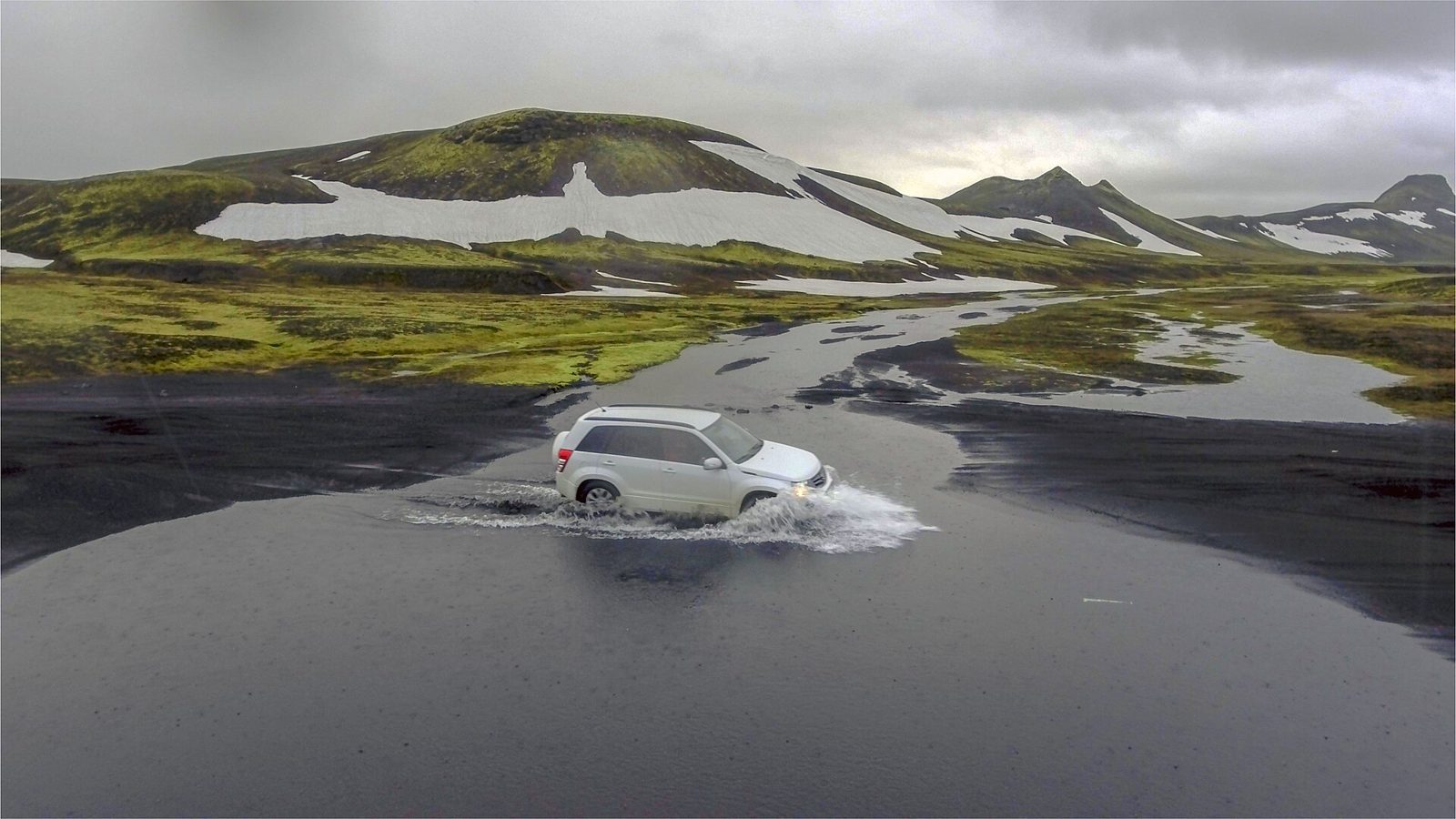
Never take a two-wheel-drive car onto an F-road. That advice is not in doubt, and nothing below softens it. What is worth getting right is why - because almost every guide tells you it is Icelandic law, and when we went looking for that law we could not find it. The real constraint is your rental contract, and it bites harder than any traffic fine: a 2WD on an F-road voids your damage cover and leaves you liable for the whole car.
The Short Answer
Take a proper four-wheel drive, matched to the specific route you plan to drive. Check the road is open on umferdin.is the morning you set out, and turn back at any river you are not certain of. Beyond that, the honest position is that "4×4 required by law" is a piece of folklore the whole industry repeats - the requirement is real, but it comes from the company that rented you the car, not from the Alþingi.
What Icelandic Law Actually Says
We searched the primary sources rather than repeating the received wisdom. The words fjallvegur, jeppi and fjórhjóladrif appear nowhere in the Traffic Act, and the regulation listing every binding prohibition sign in Iceland contains no sign restricting a road to four-wheel-drive vehicles. Here is what each instrument does and does not do.
| Legal instrument | What it actually says |
|---|---|
| Umferðarlög nr. 77/2019 (Traffic Act) | Contains no rule about drivetrain, vehicle height or ground clearance. The words fjallvegur, jeppi and fjórhjóladrif do not appear anywhere in the Act. It does let a road authority restrict or close a road (84.-85. gr.), but any such restriction must be shown by a traffic sign. |
| Reglugerð nr. 250/2024 (traffic signs) | Prohibition signs are the binding category (13. gr.), and we read the complete list of them (14. gr., signs 302 to 380) in full. They restrict by vehicle category - motor vehicles, two-wheelers, tractors, snowmobiles, lorries, buses, cyclists - and by width, height, length and weight. There is no prohibition sign restricting a road to four-wheel-drive vehicles. The highland signs travellers see at F-road junctions belong to the warning and supplementary series instead, which the regulation treats as guidance. |
| Náttúruverndarlög nr. 60/2013 (Nature Conservation Act) | Bans driving off-road outright (31. gr.), punishable by fine or up to two years in prison, rising to a minimum fine of 350,000 ISK (index-linked, 2013 figure) or up to four years where serious damage to nature results, with possible forfeiture of the vehicle (90. gr.). Driving an F-road is not off-road driving. Leaving it is. |
| Reglugerð nr. 1240/2019 (traffic fines) | Sets a 20,000 ISK fine for ignoring a temporary closure or restriction under 85. gr. of the Traffic Act, and the same for disregarding other traffic signs. This is the fine that applies if you drive past a "Lokað" barrier. |
Two things follow. First, the offences that are real - ignoring a closure, and driving off-road - carry consequences well worth avoiding, and they apply to 4×4 drivers just as much as to anyone else. Second, if a police officer stops a two-wheel-drive car on an F-road, the problem is not usually the ticket. It is that the driver has already voided their insurance.
Why A 2WD On An F-Road Can Become A Criminal Matter Anyway
There is a route from "not actually illegal" to a serious offence, and it is worth understanding before you gamble on the distinction. A two-wheel-drive car on a highland track is likely to ground out, bog down in a rut, or stall in a ford. Getting it out - or getting a recovery vehicle to it - very often means putting wheels on the moss and soil beside the track. That moment is utanvegaakstur, off-road driving, and it is unambiguously illegal under the Nature Conservation Act, with a minimum fine of 350,000 ISK and possible forfeiture of the vehicle where the damage is serious. Highland vegetation recovers over decades, not seasons. So the practical sequence is: a contractual breach that voids your cover, then a stuck car, then a genuine criminal offence committed while trying to free it.
The limits of this finding. This is a negative result, and we would rather state its boundaries than overclaim. We searched the consolidated texts of the instruments above and found no drivetrain rule, and we read the binding prohibition-sign list in full. We could not load the supplementary-plate section of the sign regulation from either public copy, so we do not quote the highland plates directly here. A reasonable counter-argument exists: 84. gr. lets a road authority impose restrictions indicated by signs, so if Vegagerðin posts a sign at an F-road junction that imposes a vehicle requirement, the legal position would be arguable. What we can say is that no such prohibition sign appears in the regulation's binding catalogue, and that no official Icelandic source we located - Vegagerðin, umferdin.is or SafeTravel - describes a legal 4×4 requirement. If you can point us to one, please tell us and we will correct this page and date the change.
Where The 4x4 Rule Really Comes From
Rental contracts, and they are unambiguous. Every operator whose terms we read prohibits two-wheel-drive cars on F-roads, names the penalty, and excludes damage caused there from the waiver you paid for. The figures below are from each company's own published terms, read in August 2026.
| Operator | Roads named as restricted | Penalty for breach | River / water damage |
|---|---|---|---|
| Höldur / Europcar | All F-roads, 35 Kjölur, 550 Kaldidalur | The full excess: 265,000 ISK (car) or 475,000 ISK (4×4) | Excluded at every tier, including ZERO |
| Hertz Iceland | All F-roads, 35, 550, and 208 to Landmannalaugar | 150,000 ISK flat | Excluded - "NOT covered at any time" |
| Blue Car Rental | All F-roads, 35, 550, 570, 26 | 300,000 ISK, or 75,000 ISK + 15 ISK/km under a second clause | Covered, but only with the Liability Waiver |
| Lotus Car Rental | All F-roads for 2WD, vans and EVs; the Krossá ford on F249 for every vehicle | Loss of cover rather than a set fine | Covered at Platinum tier; Krossá excluded outright |
| Go Car Rental | All F-roads, 35, 550, 864, F249 | 500 EUR, plus the excess | Excluded; deposit of up to 7,000 EUR |
| Icerental4x4 | All F-roads, 35, 550 - plus F249 banned for every vehicle | The full excess; 100,000 ISK for closed roads | Excluded |
Note how far the operators disagree. Only Hertz names road 208 to Landmannalaugar; only Go adds 864 at Dettifoss; F249 to Þórsmörk is banned outright by Icerental4x4, banned at the Krossá ford by Lotus, and not mentioned at all by Höldur, Hertz or Blue. The claim that no Icelandic insurance covers water damage is also false - Blue and Lotus both cover it, at their top tier only. Read your own agreement; our car rental insurance guide sets out the tiers and excesses in full.
The Roads That Are Not F-Roads But Are Treated Like Them
Kjölur (road 35) and Kaldidalur (road 550) no longer carry an F prefix. They look like ordinary numbered roads on a map, and travellers reasonably conclude a normal car is allowed. Rental companies take the opposite view: nine of the operators we checked name 35 and 550 explicitly alongside the F-roads, making this the most consistent restriction in the whole set. Drive a 2WD on either and your damage waiver is void, exactly as on an F-road. Blue Car Rental adds 570 Jökulhálsleið and 26 Sprengisandur; Go Car Rental adds 864 on the east side of Dettifoss.
How Vegagerðin Classifies Highland Tracks
The road authority does not grade highland routes by whether a 4×4 is mandatory, but by what can physically get through. These classes apply to landsvegir - the highland and moorland roads the F-numbers belong to - and they are a better guide to what you need than the F prefix alone.
| Class | Icelandic term | What can get through |
|---|---|---|
| F1 | Seinfær vegur (slow road) | Passable to all general traffic in summer. Larger streams and rivers are bridged. Usually closed in winter for snow and spring thaw. |
| F2 | Lakfær vegur (poor road) | Passable to four-wheel-drive vehicles, very capable passenger cars and crossovers. Streams and small rivers are unbridged. |
| F3 | Torfær vegur (difficult road) | Passable only to large, well-equipped four-wheel-drive vehicles and modified superjeeps. Uneven, rocky, with wet sections. |
Worth noting that F1 tracks are described by Vegagerðin as passable to all general traffic in summer. That is a technical condition class rather than permission - your rental contract still governs what you may drive, and it does not make the distinction.
When F-Roads Open
Opening is decided by inspection after the snow clears and rivers drop, so the dates move every year. Across every opening we recorded between 2021 and 2025, the earliest was 23 May (F208 north, in 2025) and the latest 15 July (F210 Keldur-Hvanngil in 2022, F821 Eyjafjarðarleið in 2021). Roads at the edge of the highlands clear first - Kjölur's median is 8 June - while the remote interior runs late, with Sprengisandur and Eyjafjarðarleið at medians of 9 to 11 July. Individual roads swing by as much as a month between years: F208 north opened on 1 June in 2023 and not until 23 June in 2022.
Our F-road opening dates page has every recorded date per road with earliest, latest and median, and a downloadable dataset. Never plan a highland trip around an average: confirm the specific road on umferdin.is the morning you drive.
River Crossings And Safety
Unbridged rivers are the defining hazard of the highlands, and the one your insurance is least likely to cover. Depths change through the day with meltwater and rain, so a ford that was easy at nine in the morning can be dangerous by late afternoon. Stop and assess every crossing on foot, watch a comparable vehicle go through first, drive slowly and steadily in low range, and turn back whenever you are unsure - there is no shame in it and no insurer behind you. Our river crossings guide covers the technique in full, including how to read the water and where to enter.
There are no services in the interior. Carry food, water and fuel for more than you plan to use, tell someone your route, and remember that mobile coverage is patchy to absent across much of the highlands.
Guides In This Section
Six pages sit under this one, going deeper on the data and the individual routes.
- F-Road Opening Dates (2021-2025) - Every recorded opening date per highland road, with earliest, latest and median, and a downloadable dataset.
- River Crossings - How to read and drive an unbridged ford, and what it costs when you misjudge one.
- F208 to Landmannalaugar - The ford-free northern approach versus the scenic southern F-road, with ford depths.
- F249 to Þórsmörk - The Krossá ford, the rental bans that name this road, and the safe ways in.
- Kjölur (Road 35) - Not an F-road in the register, yet nine rental firms ban 2WD cars on it.
- F26 Sprengisandur - Iceland's longest highland crossing: 235 km between fuel stops and the Hagakvíslar ford.
Related Guides
Elsewhere in the driving section, pair this with renting a car in Iceland to choose a suitable 4×4, the insurance guide to understand what you are actually covered for, and road conditions and safety to check status before you go. Several highland hot springs, including Landmannalaugar, are reachable only by F-road in summer.
Frequently Asked Questions
Do You Legally Need A 4x4 For F-Roads In Iceland?
Not under any Icelandic traffic law we could find, but yes in every practical sense. We searched the Traffic Act No. 77/2019 and the traffic-sign regulation No. 250/2024 and found no rule restricting roads by drivetrain, and no "4WD only" prohibition sign exists in Icelandic law. The requirement is contractual: every rental company we checked forbids two-wheel-drive cars on F-roads, and breaking that term voids your damage cover and makes you liable for the vehicle - a far larger sum than any traffic fine. Vegagerðin also classifies most highland tracks as passable only to 4×4s. Never take a two-wheel-drive car onto an F-road.
What Happens If You Drive A 2WD On An F-Road?
Your rental cover is void, so you are personally liable for damage to the car. The amounts are specific: Höldur charges the full excess of 265,000 ISK for a passenger car or 475,000 ISK for a 4×4, Hertz charges a flat 150,000 ISK, Blue Car Rental 300,000 ISK, and Go Car Rental 500 EUR - and Go discloses that its vehicles carry trackers that detect F-road use. Recovery from the highlands is not covered either, and a tow can cost more than the fine. The police are not the main risk here; your rental contract is.
There Is A Sign At Every F-Road Entrance - Does That Not Make It Law?
This is the strongest counter-argument, and it deserves a straight answer. Article 84 of the Traffic Act does let a road authority restrict use of a road, and any such restriction must be shown by a traffic sign - so in principle a signed restriction would bind. But the sign regulation No. 250/2024 sets out an exhaustive list of binding prohibition signs, and we read all of it, signs 302 through 380. It restricts by vehicle category and by dimensions and weight; there is no sign prohibiting vehicles that lack four-wheel drive. The highland signs at F-road junctions sit in the warning and supplementary series, which the regulation treats as guidance rather than prohibition. They tell you the road is impassable in an ordinary car. That is not the same as forbidding the attempt - though attempting it remains a bad idea for every other reason on this page.
What Is An F-Road In Iceland?
An F-road is a highland mountain road, marked with an "F" before its number, such as F208 or F26. The F prefix is official but comes from Vegagerðin's traffic-sign handbook rather than from any statute. They are unpaved tracks crossing Iceland's interior, with gravel, potholes, steep gradients and often unbridged rivers, and they lead to highland destinations like Landmannalaugar and Askja. They open only in summer, once Vegagerðin has inspected them.
Are Kjölur (35) And Kaldidalur (550) F-Roads?
No, and this is the trap. Both lost their F prefix and are now ordinary numbered roads, so travellers assume a two-wheel-drive car is fine. Rental contracts disagree: Höldur, Hertz, Blue Car Rental, Go Car Rental, Icerental4x4, Geysir, Route 1, Reykjavik Cars and Cars Iceland all name roads 35 and 550 alongside the F-roads, and driving a 2WD on either voids your damage waiver exactly as an F-road would. This is the single most consistent restriction across Icelandic rental terms.
When Do Iceland's F-Roads Open?
Opening is decided by inspection, not by calendar. Across every opening recorded between 2021 and 2025, the earliest was 23 May and the latest 15 July. Roads nearer the edge of the highlands clear first - Kjölur's median is 8 June - while remote interior crossings like Sprengisandur and Eyjafjarðarleið have medians of 9 to 11 July. Individual roads swing by up to a month between years, so check umferdin.is on the morning you plan to drive.
Is Driving On An F-Road The Same As Off-Road Driving?
No, and the distinction matters legally. Off-road driving - leaving the marked track - is banned outright by the Nature Conservation Act No. 60/2013, punishable by a fine or up to two years in prison, with a minimum fine of 350,000 ISK and possible confiscation of the vehicle where serious damage to nature results. Driving on an F-road itself is not an offence. SafeTravel states it plainly: F-roads and gravel roads are not off-road driving; driving off them is.
Sources
Legal position checked against the consolidated texts of Umferðarlög nr. 77/2019, Reglugerð nr. 250/2024 on traffic signs, Náttúruverndarlög nr. 60/2013 and Reglugerð nr. 1240/2019 on traffic fines. Road classification from Vegagerðin; safety guidance from SafeTravel Iceland. Rental terms read directly from each operator's published terms and conditions in August 2026. Opening dates from our own 2021-2025 dataset, compiled from Vegagerðin records. Rental terms, prices and road status all change; confirm current conditions before you travel.
Last updated: 2026-08-02 · Reviewed against official sources.